No products in the cart.

$0.00
Cart


Stand-Up Pouch vs. Flat Pouch vs. 3-Side Seal Pouch: A Buyer's Comparison
Introduction to Pouch Packaging Types
Choosing the wrong flexible pouch type isn’t a design issue. It’s an operational one that shows up in your margins, your line efficiency, and how easily you can scale. The decision between a stand-up pouch, a flat pouch, and a 3-side seal pouch directly impacts per-unit cost, production speed, shipping and storage density, retail shelf performance, consumer experience, and whether your packaging actually runs smoothly on existing filling equipment. In other words, this is less about packaging aesthetics and more about how your entire system performs from the production floor to the end user.
Within the broader world of flexible packaging, custom pouch packaging, and flexible pouch formats, each structure solves a different operational problem. Stand-up pouches are often chosen for shelf presence and resealability, flat pouches for cost efficiency and compact distribution, and 3-side seal pouches for simplicity and high-speed filling. Understanding where each format creates friction (removes it) determines whether your packaging supports long-term scalability or quietly limits it.

What Is a Stand-Up Pouch?

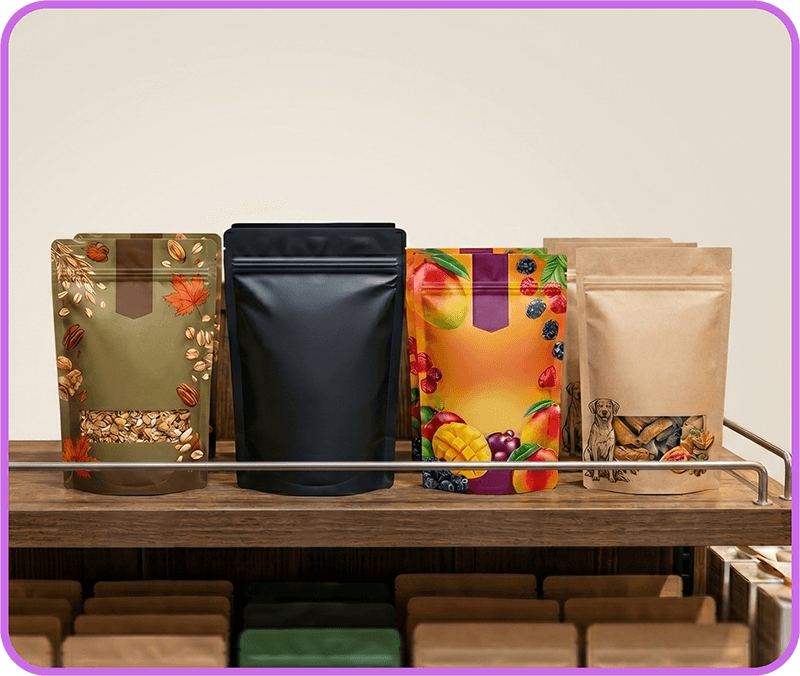
A stand-up pouch is a type of flexible packaging that features a gusseted bottom designed to expand when filled, allowing the package to stand upright on a retailer's shelf space. This structure creates a stable base that improves visibility and usability while maintaining the lightweight, efficient benefits of pouch packaging. Used for everything from pet food, liquid products, trail mix, and nutritional supplements to coffee packaging, powdered products, and baby food, it is an extremely popular packaging format in the packaging industry.
From a buyer's perspective, stand-up pouches are often chosen by many brands because they balance functionality and environmental impact with strong retail shelf presence. The upright structure creates a natural facing position that protects product integrity and maintains freshness, while enhancing visibility in competitive retail environments and improving the packaging's overall “billboard effect.” The larger front and back panels also provide a significant printable surface area, giving brands more room for design, messaging, and regulatory information without compromising clarity.
Functional features commonly associated with a stand-up pouch include a resealable zipper, tear notches for easy opening, and hang holes when peg display is required. Many formats also support high-barrier film structures, which help protect product freshness by blocking moisture, oxygen, and light—making them a strong option for food, supplement, and specialty product applications. These features combine to create a more premium, multi-use consumer experience, especially for various products intended to be opened and resealed multiple times.
Compared to flat base pouches or 3-side seal formats, stand-up pouches often carry a higher unit cost due to the added material required for the gusset and the additional manufacturing steps involved in forming the base. That added complexity is typically offset by stronger shelf impact and improved consumer usability.
Best-fit use cases for stand-up pouches
Stand-up pouches are often a strong fit for:
Overall, the stand-up pouch format is typically selected when retail shelf presence, branding impact, and resealable closures are higher priorities than the absolute lowest per-unit cost.
What Is a Flat Bottom Pouch (3-Side Seal)?

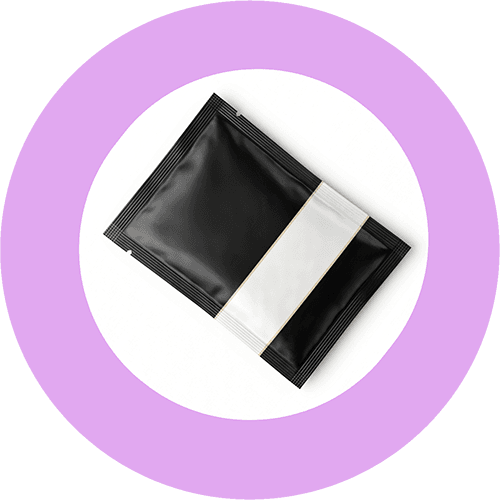
Flat bottom bags and 3-side seal pouches (three-side seal pouches) are often used interchangeably, but there are several key differences between them. They refer to a simple flexible packaging format made from film sealed on three sides, with one side left open for filling and then heat-sealed closed. Some suppliers may define the terms slightly differently, but in practice, they describe the same core structure in flexible packaging.
This format is valued for its simplicity and efficiency. Lay flat pouches typically offer lower per-unit cost, efficient shipping and storage due to their flat profile, and strong compatibility with form-fill-seal systems. They are widely used in high-volume packaging because they are easy to produce, easy to fill, and highly space-efficient in transit.
However, they do not stand upright and have limited shelf presence on their own, often requiring cartons, display boxes, or hang holes for retail presentation. They are also less suited for multi-use products unless additional features are added.
Best-fit use cases
Flat / 3-side seal pouches are often a strong fit for:
In short, flat and 3-side seal pouches are best for cost efficiency, scalability, and single-use applications where retail presence is handled outside the pouch itself.

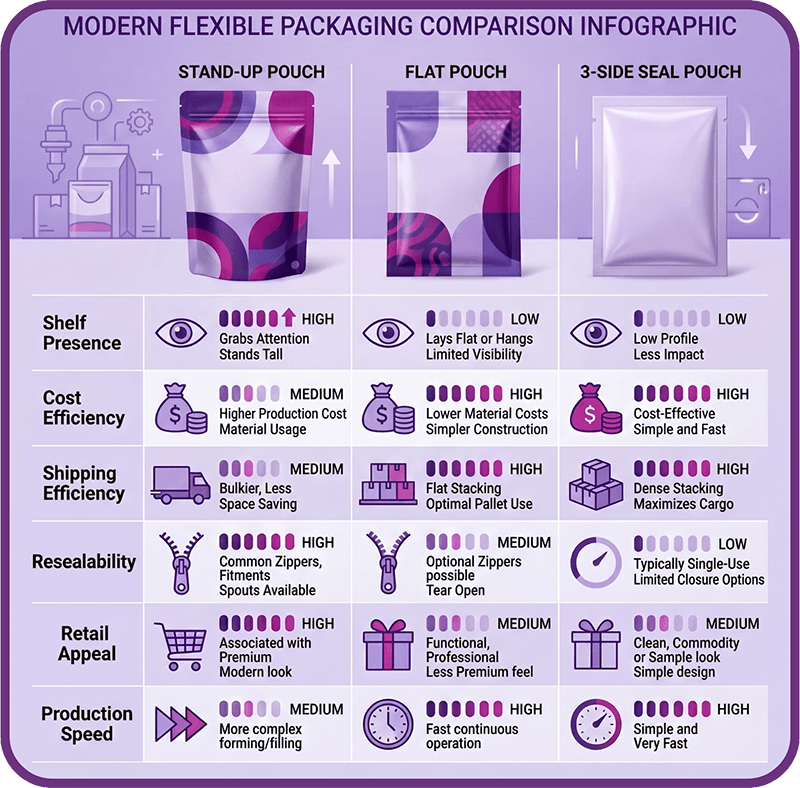
Stand-Up Pouch vs. Lay Flat Pouch: Key Differences
The two most common flexible pouch formats—stand-up pouches and flat pouches—solve very different operational and commercial needs. This comparison breaks down how each format performs across cost, shelf presence, production efficiency, and use case so buyers can quickly identify which structure best aligns with their product strategy, volume requirements, and retail goals.
Comparison Point | Stand-Up Pouch | Flat Pouch / 3-Side Seal Pouch |
|---|---|---|
Best for | Retail products, premium branding, multi-use products | Single-serve, sample-size, bulk, high-volume, or cost-sensitive products |
Shelf presence | Strong; stands upright on shelf | Limited unless used with hang hole, carton, or display box |
Typical cost | Usually higher due to bottom gusset and added manufacturing steps | Usually lower due to simpler structure |
Shipping and storage | Less compact than flat formats | Very efficient; stacks and ships flat |
Resealability | Strong fit for zippers and multi-use features | Possible in some cases, but less common for single-serve applications |
Filling compatibility | May require specific equipment depending on operation | Often compatible with simpler or faster form-fill-seal lines |
Barrier protection | Depends on film structure, not just pouch format | Depends on film structure, not just pouch format |
Best product examples | Coffee, snacks, pet treats, supplements, powders | Seasonings, samples, condiments, single-serve powders, tea, kits |
Best buyer profile | Brand prioritizing shelf appeal and consumer experience | Brand prioritizing cost, efficiency, and high-volume production |
Stand-Up Pouch vs. Flat Pouch: How They Compare
Cost Per Unit
In a stand up pouch vs flat pouch comparison, flat (3-side seal) pouches usually win on per-unit cost because they use a simpler structure without a gusset or extra forming steps. This makes them more cost-efficient, especially for high-volume or thin-margin products.
Stand-up pouches typically cost more, but the added cost can be justified when stronger shelf presence, branding, or resealability helps drive sales.
Key idea: Flat wins on cost; stand-up wins when presentation supports higher perceived value.
Shelf Display and Retail Presence
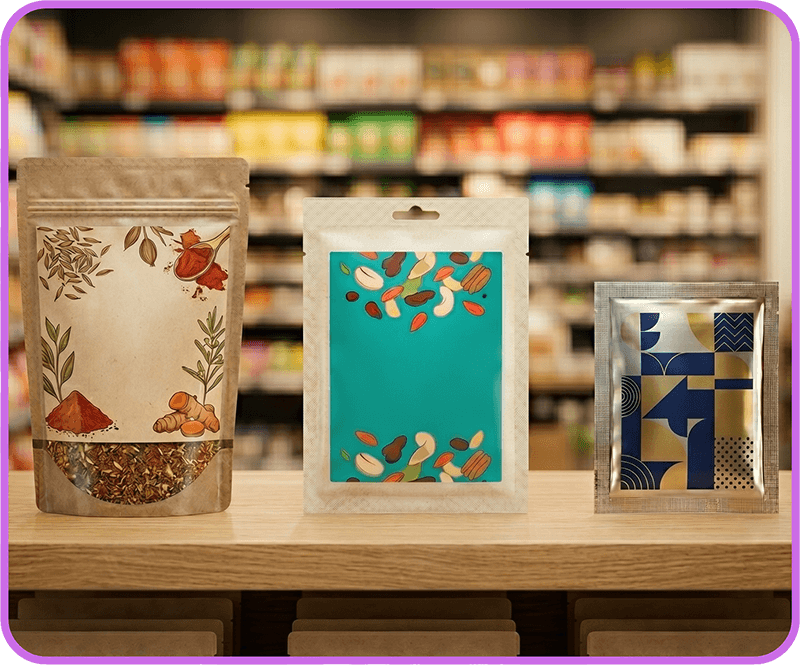
Stand-up pouches win for retail shelf presence because the gusset allows them to stand upright and creates a strong “billboard effect” for branding.
Flat pouches can work in retail but usually need hang holes, cartons, or display packaging to achieve visibility.
Key idea: Stand-up is better for competing on shelf.
Shipping and Storage Efficiency
Flat pouches win on shipping and storage because they pack completely flat and maximize space efficiency in cartons, pallets, and warehouses.
This is especially valuable for high-volume and cost-sensitive products. Stand-up pouches take up more space before filling.
Key idea: Flat formats are more efficient for logistics and storage.

Filling Line Compatibility
Both formats can work with standard equipment, but flat pouches often run more easily on form-fill-seal lines. Stand-up pouches may require more specific setup depending on the system.
Buyers should confirm compatibility with their co-packer or production team before choosing. CarePac can help evaluate this early.
Key idea: Fit depends on equipment, not just format.
Barrier and Product Protection
Barrier protection comes from the film, not the pouch format. Both stand-up and flat pouches can be built with high-barrier structures for moisture, oxygen, light, and aroma protection.
Key idea: Choose material structure, not pouch shape, for barrier performance.
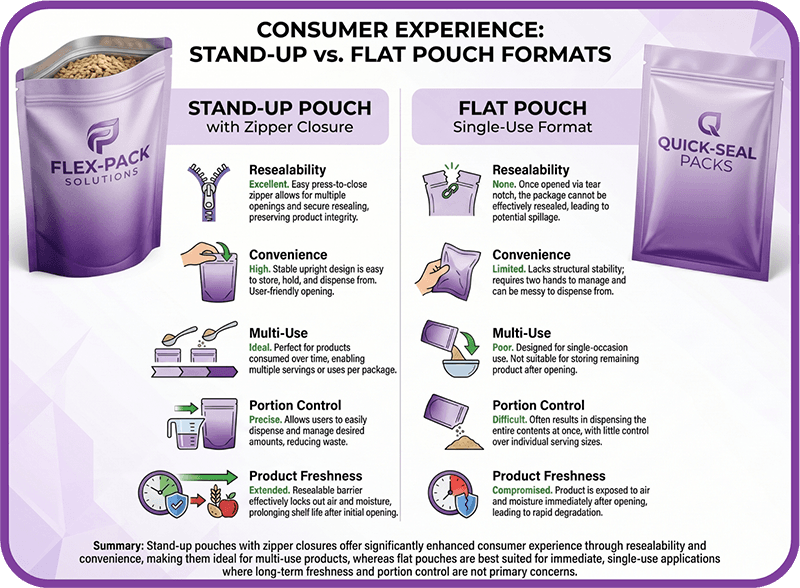
Consumer Experience and Resealability
Stand-up pouches win for multi-use products because they pair well with zippers and resealability features.
Flat pouches are better for single-use items where simplicity matters more than resealing.
Key idea: Stand-up for multi-use; flat for single-use efficiency.
Which Flexible Packaging Format Is Best for Your Product Type?
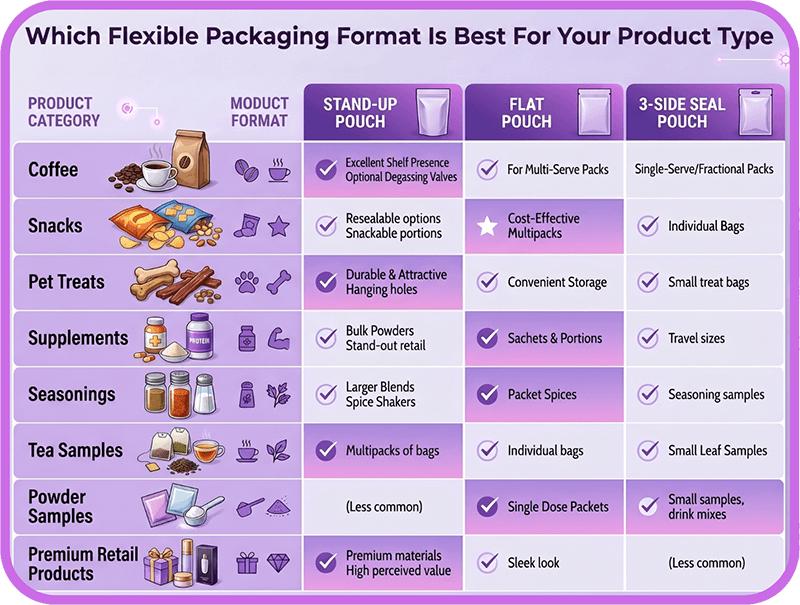
The two most common flexible pouch formats—stand-up pouches and flat pouches—solve very different operational and commercial needs. This comparison breaks down how each format performs across cost, shelf presence, production efficiency, and use case so buyers can quickly identify which structure best aligns with their product strategy, volume requirements, and retail goals.
Product Type | Recommended Format | Why |
|---|---|---|
Coffee | Stand-up pouch or flat-bottom pouch | Strong shelf presence, resealability, and freshness features such as high-barrier films and degassing valve options |
Snacks | Stand-up pouch | Better shelf presence and resealable options for multi-use products |
Seasonings | Flat pouch / 3-side seal pouch | Cost-effective for single-serve packets, samples, and high-volume runs |
Condiments | Flat pouch / 3-side seal pouch | Efficient for portion packs and single-use applications; requires less space |
Supplements | Stand-up pouch or flat pouch depending on use case | Stand-up works for multi-use powders; flat works for samples or single-serve packets |
Pet treats | Stand-up pouch | Better retail presence, visual appeal, and resealability |
Tea samples | Flat pouch / 3-side seal pouch | Compact, efficient, and suitable for sample-size and lightweight products |
Powder samples | Flat pouch / 3-side seal pouch | Lower cost and efficient for single-use servings |
Premium retail products | Stand-up pouch | Better branding surface and shelf impact |
Bulk or display-box products | Flat pouch / 3-side seal pouch | Packs efficiently and works well inside cartons or display boxes |
Who Should Use a Stand-Up Pouch?
Stand-up pouches are usually a good fit for brands that:
CarePac can help brands customize stand-up pouch size, material structure, finish, zipper, and barrier performance based on the product and sales channel.
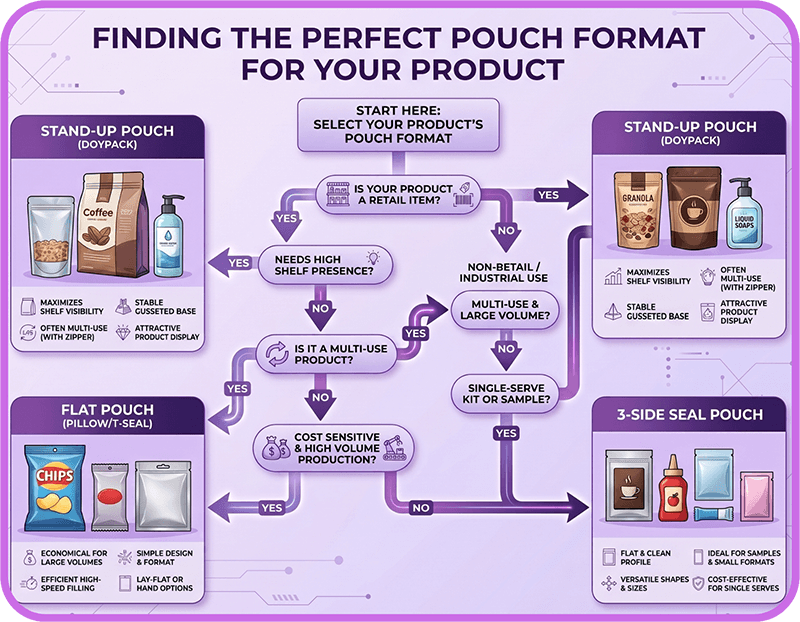
Who Should Use a Flat Pouch or 3-Side Seal Pouch?
Flat pouches or 3-side seal pouches are usually a good fit for brands that:
CarePac can help buyers confirm whether flat or 3-side-seal packaging fits their product size, filling process, barrier requirements, and order volume.
Which Pouch Format Is Right for Your Product?
Here’s how we typically walk buyers through this decision at CarePac—less theory, more “what actually works in your operation.”
Choose a stand-up pouch if:
Choose a flat pouch or 3-side seal pouch if:
If you are not sure which format fits your fill line, order volume, and distribution setup, CarePac’s team can walk you through the options before you commit to a production run. Request a quote today.
Common Mistakes to Avoid When Choosing a Flexible Pouch Format
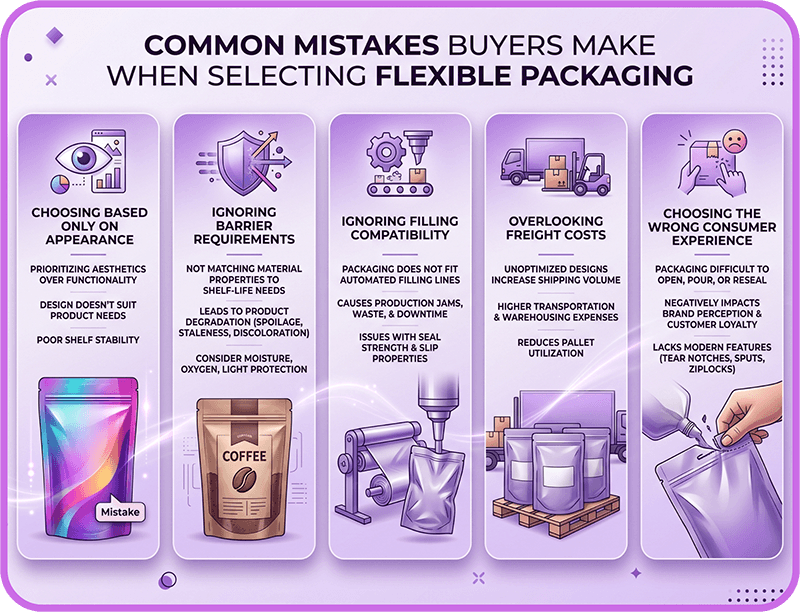
Choosing between pouch formats isn’t just a design decision—it’s an operational one. These are the mistakes we most often see when buyers select flexible packaging.
Mistake 1: Choosing Based on Looks Alone
It’s easy to default to what looks best on shelf, but appearance is only one part of the equation. The pouch also has to work with your fill line, shipping model, barrier requirements, and overall budget. A format that looks great but slows production or increases costs will create problems later.
Mistake 2: Assuming Stand-Up Pouches Always Have Better Barrier Protection
Barrier performance is determined by the film structure, not whether the pouch is stand-up or flat. Both formats can be engineered with high-barrier materials depending on what the product needs to protect against, including moisture, oxygen, light, and aroma loss.
Mistake 3: Forgetting About Filling Compatibility
A pouch can look perfect on paper but still create bottlenecks on the production floor. Different structures may require different handling or machinery, especially when working with co-packers or automated form-fill-seal systems. Always confirm compatibility before committing.
Mistake 4: Ignoring Freight and Storage Costs
Unit cost is only part of the picture. Storage efficiency, carton configuration, pallet density, and shipping volume all impact total landed cost. Flat pouches often outperform here because they pack more efficiently than gusseted formats.
Mistake 5: Choosing a Format That Doesn’t Match the Consumer Use Case
Packaging should match how the product is actually used. Multi-use products typically need resealability and better handling, while single-use products often benefit from simpler, lower-cost formats that prioritize efficiency over reusability.
Verdict: Stand-Up Pouch vs. Flat Pouch vs. 3-Side Seal Pouch
There is no single “best” pouch format—only the format that best fits your product and operation.
Stand-up pouches are typically the stronger choice when shelf presence, resealability, branding, and consumer experience are priorities. Their ability to stand upright and showcase a larger branded surface area makes them especially effective for retail products and premium product lines.
Flat pouches and 3-side seal pouches are usually the stronger choice when cost efficiency, compact shipping, single-serve applications, or high-volume production matter most. Their simple structure helps reduce costs while maximizing storage and distribution efficiency.
Ultimately, the right choice depends on your product, filling process, order volume, distribution channel, barrier requirements, and how customers will interact with the package after purchase.
CarePac can help brands compare pouch formats, materials, features, and custom configurations before placing a packaging order, ensuring the final solution aligns with both operational requirements and brand goals.
Frequently Asked Questions
Lets Get Started

Made In
The USA

Full Pouch
Customization

Scalable Printing
Digital & Plate
Latest From The Blog
© 2025 CarePac. ISO 9001:2015 CarePac, Family Owned Flexible Packaging
Legal | Capabilities | Privacy