No products in the cart.

$0.00
Cart


Best Flexible Pouch Formats for High-Volume Food Brands
When it comes to high-volume food buyers and manufacturing companies, you face different trade-offs and issues than smaller food brands do. At scale, a cost-per-unit difference of a few cents can add up to six figures (or more!) annually, while the wrong pouch format can create friction on the fill line or in the warehouse, be detrimental to consumer convenience, or affect shelf visibility in retail. In this article, we'll break down the best flexible packaging types for high-volume food brands, along with several factors to consider when purchasing.

Stand-Up Pouch Packaging: The Retail Workhorse for Food Brands
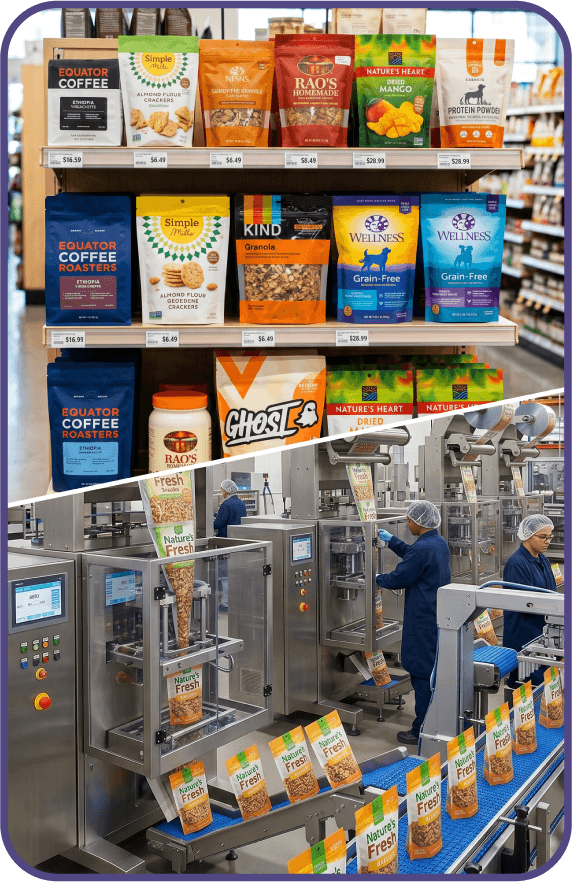
Stand-up pouch packaging is the most widely used flexible packaging format for frozen food, dry snacks, baby food, coffee beans, pet food, supplements, liquids, dried fruits, personal care products, powders, sauces, heavy products, and dried goods. Not only does this type of packaging provide barrier protection, but the gusseted bottom construction is essential, as it enables the stand-up pouch to stand on a shelf or retail display. It's also beneficial to brands because it enables a "billboard effect" at the point of purchase, as the entire front (and really, all four sides) of the recyclable or compostable pouch can be customized with branding, your website, or text to your preference.
There are several benefits to stand-up pouch packaging, particularly for high-volume food brands. This type of packaging is available in rollstock for form-fill-seal lines and is compatible with VFFS (vertical form-fill-seal) and HFFS (horizontal form-fill-seal) equipment. Stand-up pouch packaging is ideal for any retail food product where the brand competes visually on a shelf; in these situations, the extra cost per unit pays back in velocity. In terms of limitations, the higher per-unit cost might not be the right call for every product.
Flat Bottom Pouches: Premium Shelf Presence for Flagship SKUs
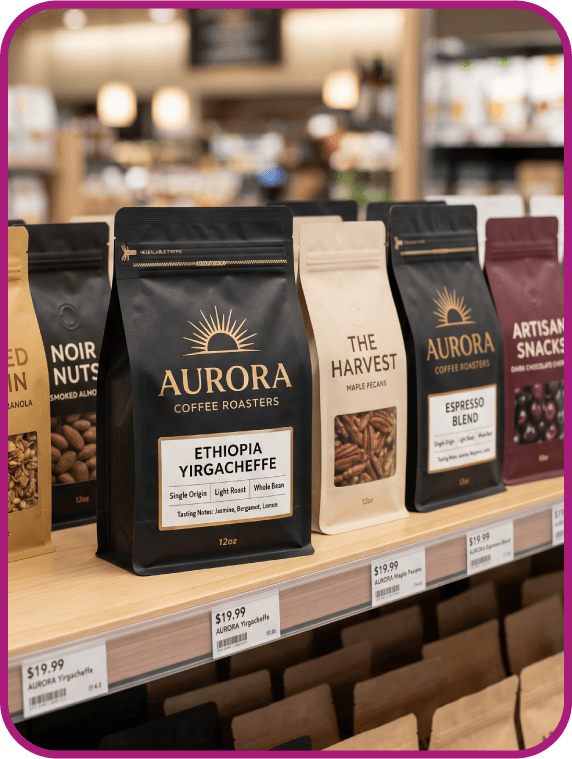
Flat-bottom gusset pouches are a step up from a standard pouch and other more basic sustainable packaging options. They're more structured and feel more premium, making them a great option for flagship or hero SKUs where the brand wants a box-like appearance without the cost and sustainability tradeoffs of a carton. While a stand-up pouch has a gusset that enables it to stand upright on a shelf, the construction of a flat-bottom pouch is a bit different: it has a rectangular, flat base and side gussets that create box-like stability, with a full printable surface on all panels.
One important thing to note about flat-bottom pouches is that they require different filling equipment from standard mono-material doypacks, so you may need to flag this with your co-packer before purchasing. If you sell specialty coffee, gourmet snacks, premium nuts, tea, or any food or snack category that commands a higher price, this higher-quality, rigid packaging can help your product stand out on the shelf.
Side Gusset Pouches: High Capacity for Coffee, Tea, and Bulk Food Products
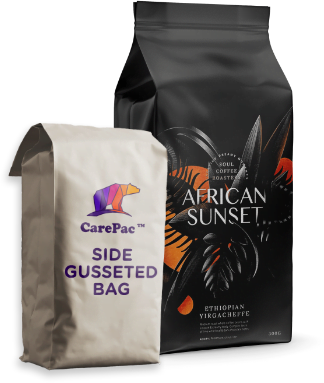
Side gusset pouches have expandable folds on both sides (rather than the bottom), creating a flat front and back panel with depth for high-fill-weight products. What sets side gusset pouches apart from other types of high barrier pouches is the flat front panel: it offers an uninterrupted, undistorted print surface at any fill weight. This type of packaging is common in both retail and food service/bulk formats and is great for high-volume purposes: coffee roasters, tea brands, bulk nuts, and pet food. If you have heavy or high-volume fills that a standard doypack would underfill, this is the best choice for you.
As with the other packaging types on this list, side gusset pouches provide enhanced barrier properties and can be customized to include custom shapes or features like a resealable zipper, child-resistant properties, or a degassing valve, and can be made from different types of materials, such as plastic or kraft paper.
3-Side Seal Pouches: The High-Volume, Low-Cost Flexible Packaging for Single-Serve Food
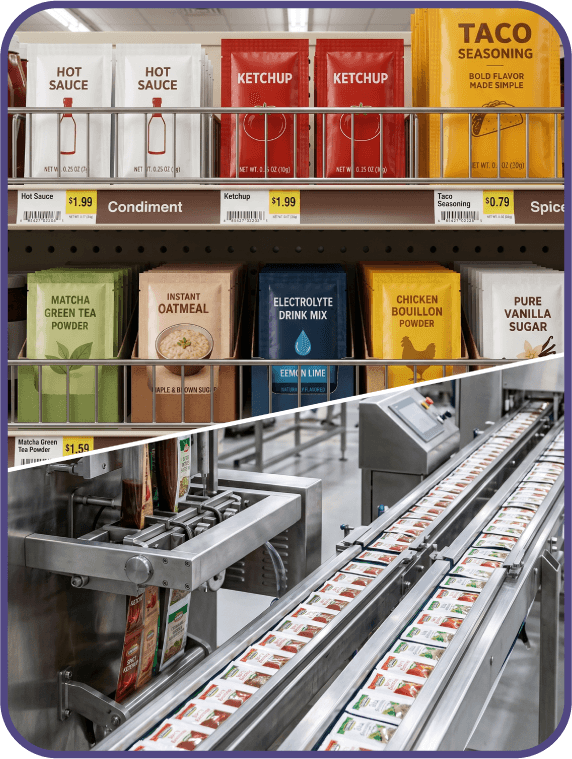
For food brands that produce high volumes of single-serve products, 3-side-seal pouches are often the most cost-effective packaging format. Commonly used for spice packets, seasoning sachets, condiment portions, powdered drink mixes, and product samples, these pouches are designed for efficiency at scale. Their flat construction requires less material than gusseted formats, reducing per-unit packaging costs while also lowering freight expenses by allowing more units to ship in each case.
While they are often associated with lower costs, 3-side seal pouches should not be viewed as a "cheap" packaging option. Rather, they are the operationally correct choice for many high-volume, single-serve applications. In fact, numerous large food brands use 3-side seal pouches as their primary packaging format for portion-controlled products while reserving stand-up pouches for larger retail sizes. They are particularly well-suited for foodservice portioning, single-serve condiments, ingredient packets, product sampling programs, and subscription box inclusions, where efficiency, consistency, and cost control are key priorities.
Choosing the Right Flexible Food Packaging for Your Food Operation
For most food brands, pouch selection is less about aesthetics and more about operational fit. The right structure is usually determined by three core questions that directly impact production efficiency, distribution cost, and long-term profitability.
1. What does your fill line look like?
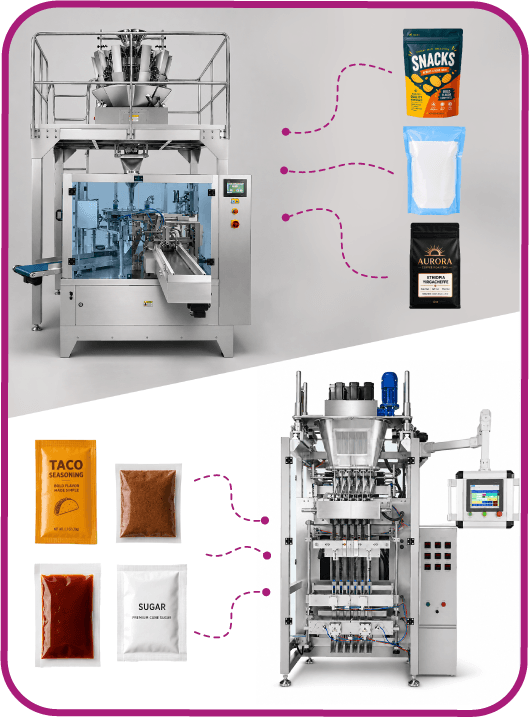
Your equipment often narrows the decision before anything else. Stand-up pouches, flat-bottom pouches, and side-gusset formats typically run on vertical form-fill-seal (VFFS) systems or compatible premade-pouch filling equipment. By contrast, 3-side seal pouches are optimized for high-speed horizontal form-fill-seal (HFFS) lines. If your operation is already invested in a specific filling system, the machinery will naturally dictate which formats are viable and which would require costly retooling or process changes.
2. What channel are you selling into?
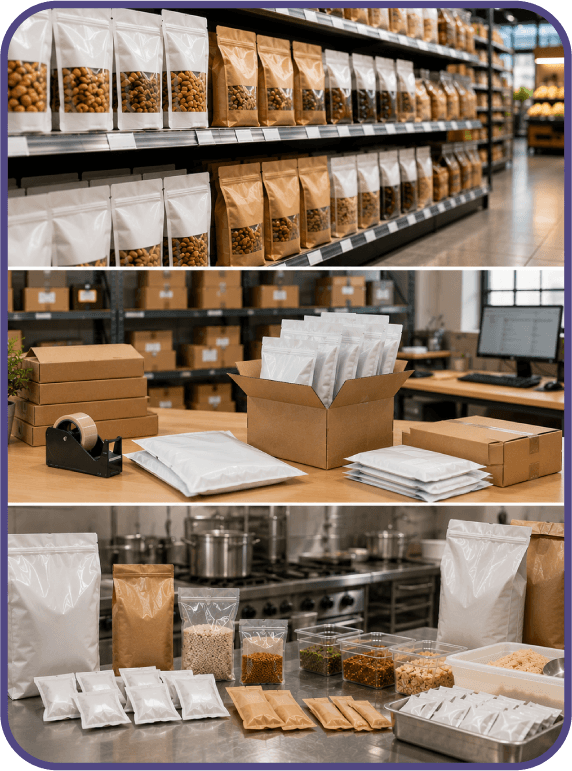
Your go-to-market channel should strongly influence format choice. Retail shelf presence benefits from structures with strong shelf stability and billboard impact, such as stand-up pouches, flat-bottom pouches, and side-gusset bags. E-commerce and subscription programs often prioritize shipping efficiency, in which flat formats and 3-side seal pouches perform well because they stack tightly and reduce dimensional weight in mailers. Foodservice applications, on the other hand, typically rely on 3-side-seal sachets or larger side-gusset bags for portion control and bulk-dispensing efficiency.
3. What does your margin math look like per SKU?
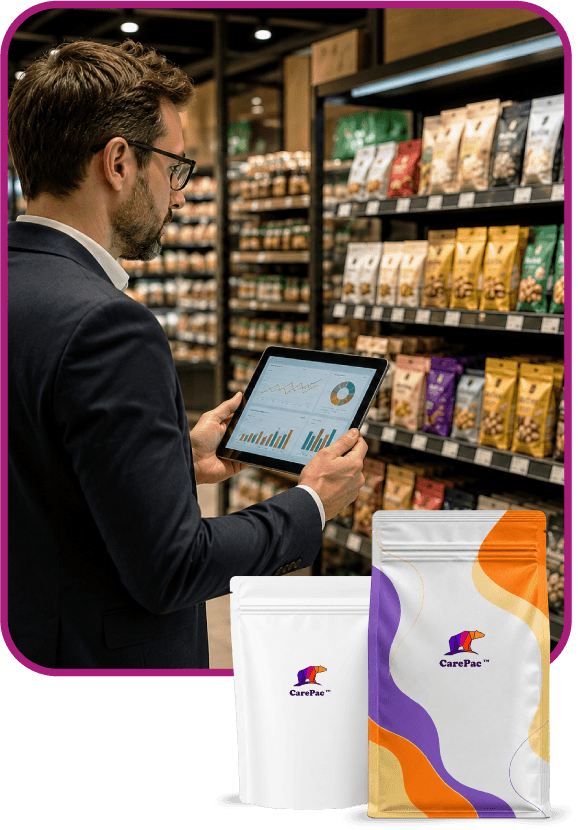
Cost per unit matters, but only in context. A slightly more expensive pouch format that improves retail visibility and sell-through can ultimately outperform a lower-cost option that slows shelf movement. The real decision comes down to balancing packaging costs against expected velocity, shrink risk, and replenishment cycles. In many cases, the most profitable structure is not the cheapest per unit—it’s the one that optimizes total SKU performance across production, distribution, and retail execution.
CarePac works with food brands at every volume level. If you're evaluating formats or looking to optimize an existing run, request a quote and our team will match you to the right structure.
Best Pouch for Food Packaging: FAQs
Lets Get Started

Made In
The USA

Full Pouch
Customization

Scalable Printing
Digital & Plate
Latest From The Blog
© 2025 CarePac. ISO 9001:2015 CarePac, Family Owned Flexible Packaging
Legal | Capabilities | Privacy