
Coffee Degassing Valves & Barrier Films
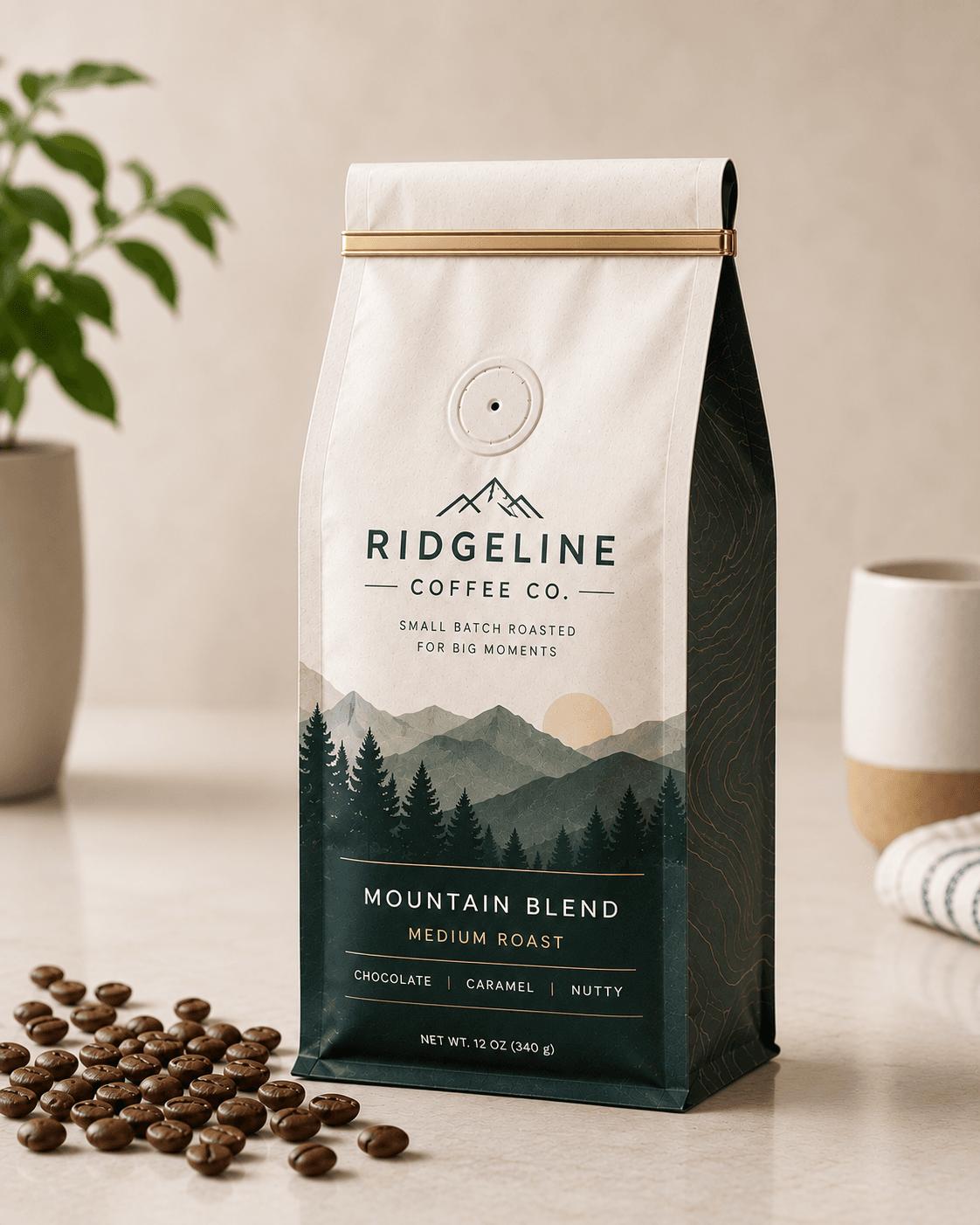
Freshly roasted coffee continues to release carbon dioxide after roasting. A one-way degassing valve allows gases to escape from a sealed pouch while preventing oxygen, moisture, and outside contaminants from spoiling the freshly roasted beans. Paired with the right high-barrier film structure, the valve helps protect package integrity, aroma, and product quality throughout distribution.
One-way valves relieve pressure from gases released by roasted coffee beans while maintaining the package’s protective barrier. They can also allow roasters to package coffee sooner instead of holding it for an extended bulk-degassing period.
CarePac can help coffee brands engineer a custom pouch structure based on roast profile, product format, filling process, expected shelf life, and distribution conditions. Our coffee packaging helps keep coffee fresh by blocking oxygen and allowing controlled off-gassing.
Why Freshly Roasted Coffee Requires Specialized Packaging
Coffee packaging must manage several factors simultaneously, including carbon dioxide released after roasting, oxygen exposure, moisture ingress, light exposure, aroma loss, seal strength, distribution and altitude changes, and consumer habits surrounding opening and resealing. Additionally, the product's actual shelf life depends on the coffee type, roast, grind, residual oxygen, packaging structure, sealing process, and storage environment. Your coffee simply cannot have a long shelf life without proper packaging that offers high oxygen barrier performance.
How a One-Way Coffee Degassing Valve Works
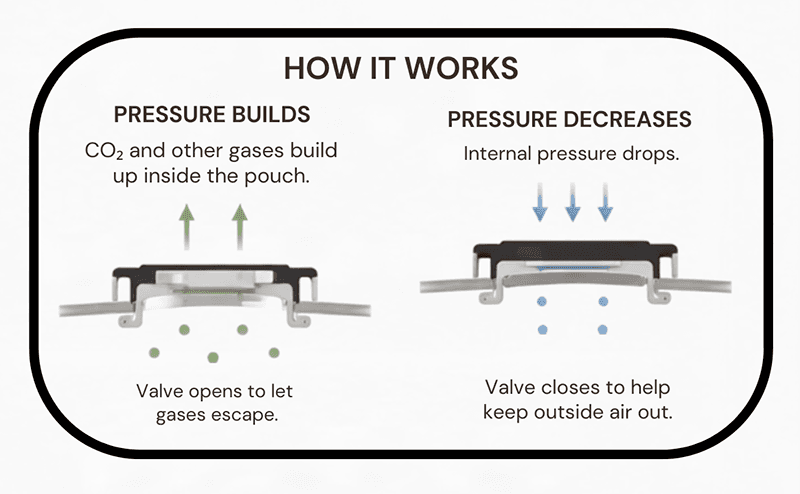
A one-way coffee degassing valve is installed over an opening in the packaging film to let gases generated by freshly roasted coffee escape while limiting oxygen and moisture from entering the pouch. As CO₂ and other gases build pressure inside the stand-up pouches, the pressure activates the valve and allows gas to move outward; as internal pressure decreases, the valve closes to help protect the coffee from outside air. The valve must also be compatible with the package’s overall barrier system, including the film structure and seal design, to support the intended packaging performance.
One-way coffee valves can use multiple components, such as a cap, flexible disc, viscous or sealing layer, base plate, and filter, although the specific construction varies by manufacturer and valve design. Because valve construction and performance can differ, evaluate the valve as part of the complete coffee packaging system rather than as an isolated component.
When Does Coffee Packaging Need a Degassing Valve?
Since coffee beans and ground coffee continue to release gases after roasting, a degassing valve is almost always essential for maintaining freshness and extending shelf life of your product.
A degassing valve is not a substitute for a high-barrier film.
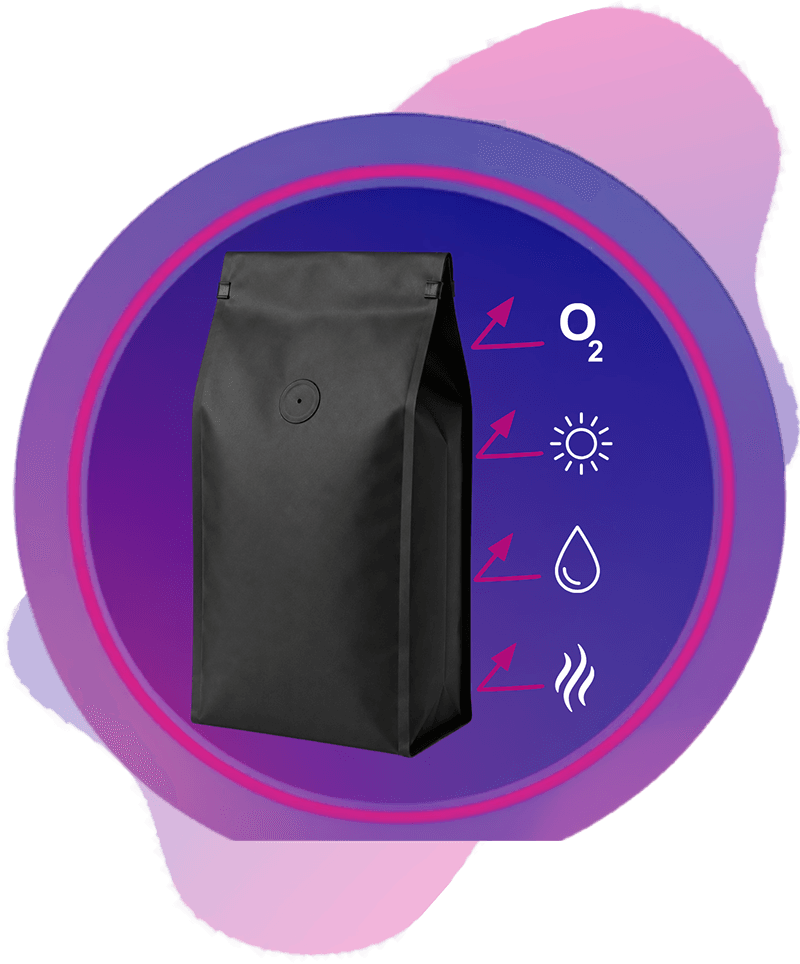
The valve controls pressure and gas release, and the film structure protects the package across its full surface area from oxygen, moisture, light, and physical damage.
What Barrier Properties Matter for Coffee Packaging?
Coffee packaging must balance several barrier and structural properties to help protect freshness, flavor, aroma, and overall product quality. Oxygen, moisture, light, external odors, and seal performance can all affect how well a package protects coffee during filling, storage, transportation, and distribution.
Oxygen Barrier
Oxygen exposure can contribute to oxidation and the degradation of compounds responsible for coffee’s flavor and aroma. OTR, or oxygen transmission rate, measures how quickly oxygen passes through a packaging material after the roasting process, and a lower OTR generally indicates greater resistance to oxygen transmission. Evaluate OTR for the complete laminate rather than by the name of an individual material, and always consider testing conditions when comparing results. No universal OTR requirement exists for every coffee application; the appropriate target depends on the product, packaging structure, storage conditions, and other application-specific factors.
Seal Integrity
Even a high-barrier packaging structure cannot perform as intended if the finished package has weak or compromised seals. Sealant compatibility, appropriate sealing temperatures, contamination in the seal area, and filling-line settings can all affect seal integrity, while drops, compression, vibration, and other transportation stresses can place additional demands on the finished package. For this reason, seal performance should be considered alongside barrier properties when evaluating a coffee packaging structure.
Light Barrier
Light exposure can contribute to changes in coffee quality, particularly when the product is exposed for extended periods. Opaque packaging structures, metalized films, and foil layers can help reduce the amount of light reaching the coffee. The appropriate level of light protection depends on the product, package format, storage environment, and desired level of protection.
Aroma and Odor Barrier
Coffee contains volatile compounds that contribute to its distinctive aroma and sensory profile, making aroma retention an important packaging consideration. An effective package should help retain desirable volatile compounds while also limiting the potential for external odors to migrate into the package. Material selection and the overall packaging structure can influence how effectively the package provides this type of protection.
Moisture Barrier
WVTR (Water Vapor Transmission Rate) measures how quickly water vapor passes through a packaging material and indicates its moisture-barrier performance. Effective moisture protection can help maintain coffee quality by limiting the effects of environmental humidity during storage and distribution. The appropriate moisture barrier depends on factors such as storage conditions, distribution environment, package structure, and desired shelf life.
Common High-Barrier Film Structures for Coffee Bags
PET / Metallized PET / PE
A PET / metallized PET / PE structure combines different layers, with each material serving a specific function. PET is commonly used as the outer layer for printability, stiffness, and durability; metalized PET can enhance oxygen, moisture, and light barrier performance; and PE typically serves as the product-contact layer while providing heat-seal functionality.
Metalized films can provide significantly greater oxygen, moisture, and light protection than uncoated PET, although actual performance depends on factors such as the metallization or coating, laminate quality, handling, and conversion process. Foil can provide even higher barrier protection in appropriate packaging structures, making it an option for applications with more demanding barrier requirements.
PET / Aluminum Foil / PE
A PET/aluminum foil / PE structure can provide very high barrier performance against oxygen, moisture, and light, making it well suited for coffee applications with demanding shelf-life or distribution requirements. PET provides printability, stiffness, and durability; the aluminum foil layer provides strong barrier and light protection; and PE serves as the product-contact and heat-seal layer.
The trade-offs include higher material cost, complete opacity, potentially greater stiffness, and recyclability considerations depending on the overall package structure and applicable recycling systems. While aluminum foil can provide an exceptionally high barrier at the material level, it should not be treated as providing zero transmission in a finished pouch; pinholes, folds, seals, handling, and converting quality can all influence package-level performance.
PET / EVOH-Based Barrier / PE
A PET / EVOH-based barrier / PE structure uses EVOH as an oxygen-barrier component within the laminate. EVOH provides strong oxygen resistance, but humidity can affect its barrier performance, so the surrounding layers are important for protecting the EVOH and maintaining its effectiveness.
Depending on the complete laminate and package design, EVOH-based structures may support applications where transparency is desired or where brands are pursuing more recyclable-oriented packaging options. Actual performance and recyclability depend on the specific materials, layer construction, thicknesses, and package design, not on the presence of EVOH alone.
Mono-Material PE or PP Structures
Mono-material PE or PP structures may offer potential compatibility with certain recycling streams, depending on the specific structure, local recycling infrastructure, and applicable guidelines. However, simplifying the material structure can involve performance tradeoffs, so evaluate oxygen and moisture barrier performance alongside the compatibility of components such as degassing valves, zippers, and seals.
Evaluate the complete pouch rather than assuming the base film alone determines package performance. Factors such as laminate construction, barrier coatings, closures, seals, filling conditions, and converting quality can all influence how the finished package performs in its intended application.
Kraft-Look Coffee Packaging
“Kraft” typically describes the exterior appearance or a Kraft paper component of the package; it does not, by itself, indicate the package’s oxygen, moisture, or overall barrier performance. A kraft-look coffee pouch may use a multilayer internal structure beneath the exterior to provide the required barrier, product-contact, and heat-seal properties while maintaining the desired natural or paper-like appearance.
Metallized Film vs. Aluminum Foil for Coffee Packaging
Consideration | Metallized Film | Aluminum Foil Laminate |
|---|---|---|
Oxygen barrier | High, depending on structure | Typically very high |
Moisture barrier | High, depending on structure | Typically very high |
Light protection | Strong | Opaque |
Flexibility | Generally flexible | Can be more prone to flex-related damage |
Cost | Often lower than foil | Often higher |
Visibility window | Not through metallized area | Not through foil area |
Sustainability considerations | Depends on complete laminate | Depends on complete laminate |
Best use | Many retail coffee applications | Demanding shelf-life or distribution conditions |
You cannot select the correct material from a generic table alone. We will help you evaluate the coffee format, target shelf life, package dimensions, filling process, shipping conditions, and commercial requirements before recommending a structure.
Valve Selection Factors That Impact Coffee Freshness
Selecting a one-way coffee degassing valve involves more than choosing a valve based on its general function. Consider the valve, film structure, pouch format, filling process, and intended distribution conditions together to ensure the finished package performs as intended.
Valve Opening Pressure
The valve should open within an appropriate internal-pressure range, so gases generated by the coffee can escape without unnecessarily compromising package performance. A valve that opens too early or too late may not relieve pressure as intended, so the appropriate specification should match the coffee and package design. Provide numerical pressure specifications only when validated information is available from CarePac or the applicable valve manufacturer.
Valve Flow Rate
Valve flow rate describes how effectively the valve can release gas from the package once the appropriate internal pressure is reached. The valve should accommodate the coffee’s expected CO₂ release profile without creating unnecessary pressure buildup. Valve selection should therefore consider factors such as the coffee, roast, packaging conditions, and expected degassing behavior.
Valve Placement
Valve placement can affect both package performance and production considerations. The location should provide adequate filling clearance while accounting for headspace, package appearance, consumer handling, valve application equipment, and the position of zippers and seals.
Internal vs. External Valve Application
One-way valves can be applied using different methods, depending on the valve design and packaging process. The appropriate application method should be based on the equipment, pouch construction, and production requirements.
Valve and Film Compatibility
The valve must be compatible with the film structure and the conditions used to apply it to the pouch. Factors such as adhesive or heat-seal compatibility, film thickness, surface treatment, laminate stiffness, barrier continuity, and conversion and application conditions can all affect the finished connection and package performance.
Food-Contact and Compliance Documentation
Brands should request relevant food-contact, migration, and supplier compliance documentation based on the product, packaging materials, intended conditions of use, and destination market. Rather than describing a component simply as “FDA approved,” evaluate packaging materials against applicable food-contact regulations and requirements for their specific intended use.
Matching the Film and Valve to the Coffee Product
Product or Operational Factor | Packaging Question |
|---|---|
Whole bean vs. ground | How quickly will the product release retained gas? |
Roast level | Does the roast profile affect the expected degassing behavior? |
Roast-to-pack timing | How soon after roasting will filling occur? |
Package size | How much product and headspace will the pouch contain? |
Shelf-life target | How long must the package maintain the desired quality? |
Distribution | Will the product face heat, humidity, altitude or long transit times? |
Sales channel | Is the coffee sold DTC, in retail, through foodservice or internationally? |
Filling equipment | What sealing temperatures, speeds and pouch tolerances are required? |
Consumer use | Is a zipper or other reclosure feature needed? |
Sustainability target | Which performance characteristics must be maintained while changing materials? |
How Pouch Format Affects Coffee Packaging Performance
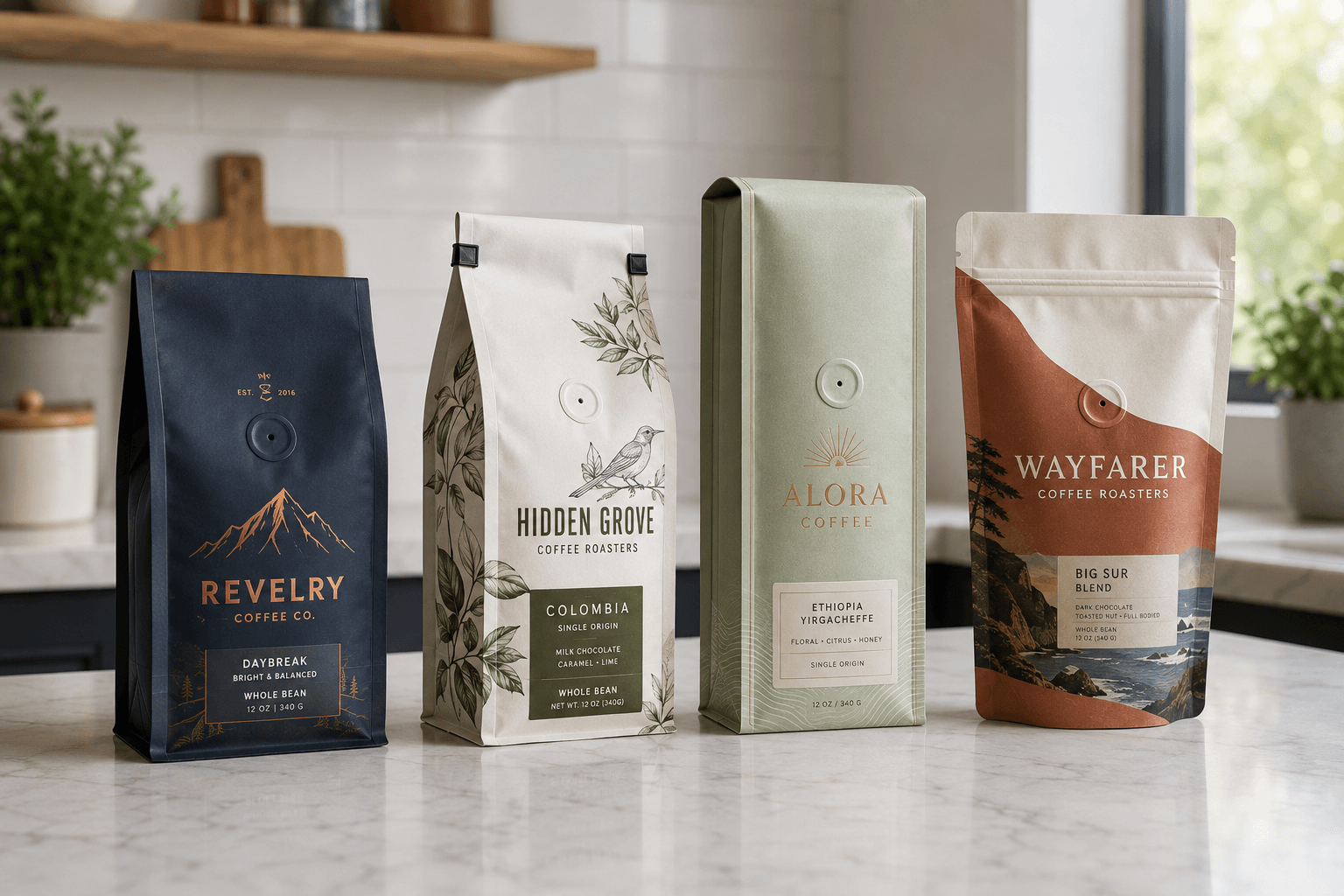
Pouch format influences how the packaging is constructed, filled, sealed, displayed, and handled. Across each format, the film structure, degassing valve, seals, closures, and other components should be selected and engineered together to meet the product’s barrier and performance requirements.
Additional Coffee Pouch Features
Coffee pouches can be customized with a range of functional and visual features to support usability, branding, and shelf presentation:
Each added component or finishing option can affect other aspects of the package, including recyclability, barrier continuity, machinability, lead time, and unit cost. Features should therefore be evaluated as part of the complete pouch design to ensure they are compatible with the intended materials, filling process, performance requirements, and production volumes.
Why Work With CarePac on Coffee Packaging?
